REVIEW · BELGRADE
Architecture of New Belgrade – Brutalism Decoded
Book on Viator →Operated by Walking Belgrade · Bookable on Viator
Concrete tells stories in New Belgrade. This brutalist architecture tour turns heavy concrete into real context, pairing five major stops with everyday life stories that stretch from the 60s and 70s into harder 90s years. The only watch-out: you move briskly between sites, so it is not a slow, linger-and-learn kind of day.
I like how straightforward it is to start. You meet your guide at the Museum of Contemporary Art at Ušće, then you end at Sava Center, so the route feels logical instead of wandering. The pace also includes some car time for the big sights between neighborhoods, which helps you see more in 2 hours 30 minutes.
At $86.42 per person, the value comes from the focus: guided decoding of New Belgrade’s postwar built world, not just photo stops. Four of the stops are free, while the Museum of Contemporary Art ticket is not included, so budget for that one entry separately.
In This Review
- Key highlights you will care about
- Entering New Belgrade brutalism without the jargon fog
- Start at Museum of Contemporary Art Ušće: modern volumes plus marble contradictions
- Park Prijateljstva: trees, peace, and the Non-Aligned Movement
- A drive-by of the Government Building: the Yugoslavia shift in construction form
- Genex Tower at Narodnih heroja 45: the Western City Gate of Belgrade
- Sava Center: the congress machine built fast, still feeling usable
- Block 23 and Primary School Laza Kostić: concrete expressionism with real routines
- Price and timing: is $86.42 per person good value?
- Should you book Architecture of New Belgrade – Brutalism Decoded?
- FAQ
- Where do I meet the guide?
- When does the tour end?
- How long is the Architecture of New Belgrade – Brutalism Decoded tour?
- Is this a private tour?
- What language is the tour offered in?
- Do I need tickets for the stops?
- Is the tour near public transportation?
- Is it suitable for most travelers?
- Is there free cancellation?
- FAQ
- What kind of ticket do I get?
- Is confirmation provided after booking?
Key highlights you will care about
- Five buildings in about 2.5 hours with built-in context, not just sight-seeing
- Park Prijateljstva history tied to the Non-Aligned Movement and peace symbolism
- Genex Tower at Narodnih heroja 45 with brutalism credentials and real-city nicknames
- Sava Center still in use plus interior design notes that feel current
- Block 23 life at Primary School Laza Kostić where architecture meets daily routines
- Private tour format for more back-and-forth questions in English
Entering New Belgrade brutalism without the jargon fog
New Belgrade can look like one big “concrete everywhere” puzzle at first. What makes this tour worth it is how your guide explains what you are actually seeing, and why it was built that way. Instead of treating brutalism as a style to admire from a distance, you get a clear thread linking politics, materials, and how people lived inside these structures.
I also like the human angle. The tour connects big buildings to the routines that happened behind the façade: work, school, and community life in the blocks during the strong decades, and the slower, tougher feelings later on. You end up with a better read on the city, not only a list of landmarks.
One consideration: because you cover five stops in a short window, you will likely have less time for long photo marathons at each location. If you love lingering, you can still grab pictures, but this tour is built for momentum.
You can also read our reviews of more tours and experiences in Belgrade.

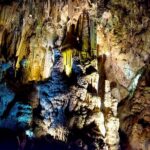

Start at Museum of Contemporary Art Ušće: modern volumes plus marble contradictions
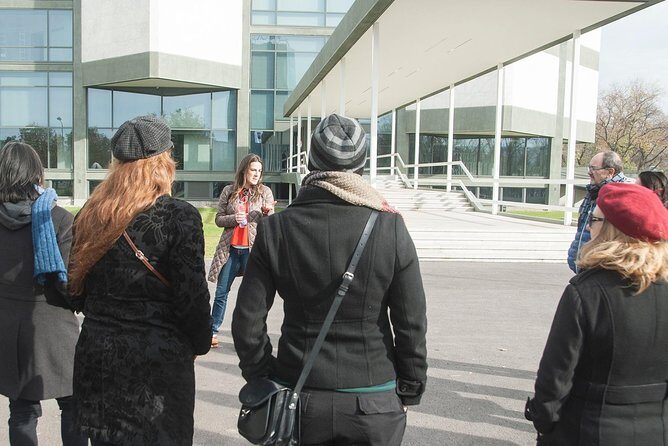
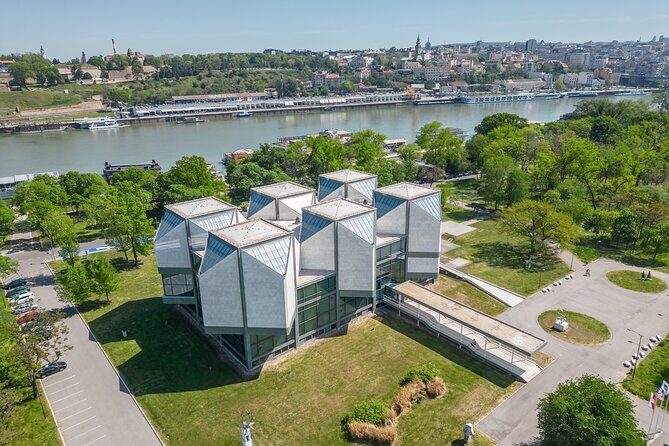
You kick off at the Museum of Contemporary Art at Ušće, where the meeting point is right out front. Your guide spends time on the museum’s modernist 1960-ies volumes, then pushes a great talking point: why the precious marble facades seem to contradict the usual expectations people have for socialist-era architecture.
This is a smart first stop because it sets the tone for the whole tour. The message is simple: New Belgrade design is not one-note. Even within a broader postwar modern mood, you get contradictions—materials and messages that do not match the stereotypes.
Plan for about 20 minutes here. The only practical snag is that the admission ticket is not included. If you want to avoid any last-minute stress, factor in time to sort that out before or on arrival.
Park Prijateljstva: trees, peace, and the Non-Aligned Movement
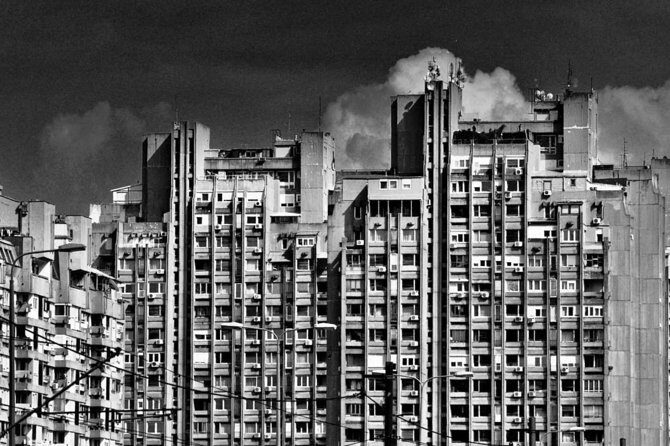
Next comes the Park of Friendship, Park Prijateljstva. This is a quick 15-minute stop, but it carries weight. Your guide ties the park to the Non-Aligned Movement of 120 countries, founded in Belgrade in 1961. The key detail here is that heads of state planted the trees in the park as a peace symbol.
I love that this is not treated as a random green patch. It is architecture and planning used as diplomacy, turned into something you can stand in front of and understand. Even if you are not a political history person, you will likely find the symbolism easy to grasp once your guide frames it.
Admission is free here, so you can keep the budget simple. This stop also works well as a breathing moment between the larger, harder-edged buildings.
A drive-by of the Government Building: the Yugoslavia shift in construction form
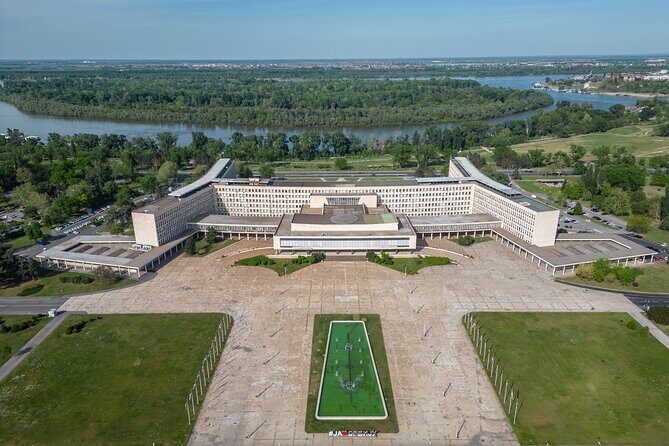
Between the park and the next major architecture stop, you drive by a huge Government Building. This is presented as a monument to an earlier phase of Yugoslav (YU) politics, including the switch away from Stalin while the building was under construction.
You do not need to memorize the politics to benefit from this moment. The value is in training your eye to notice that buildings can show “in-progress” ideas—what leadership wanted when plans were still being written. It is architecture as evidence of changing power.
This segment is also why the tour is time-efficient. You get the sightline and explanation without spending precious walking minutes trying to place it yourself.
Genex Tower at Narodnih heroja 45: the Western City Gate of Belgrade
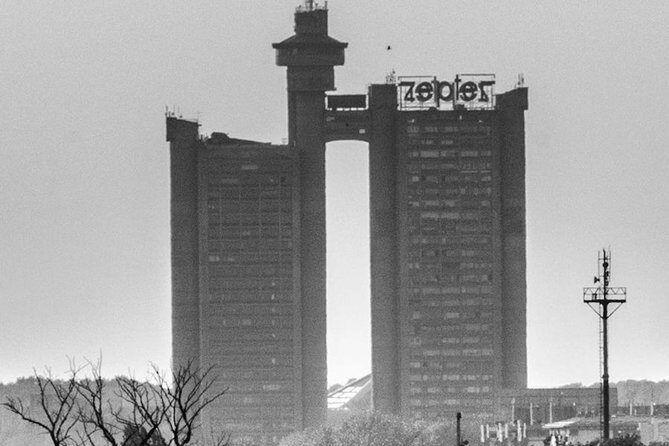
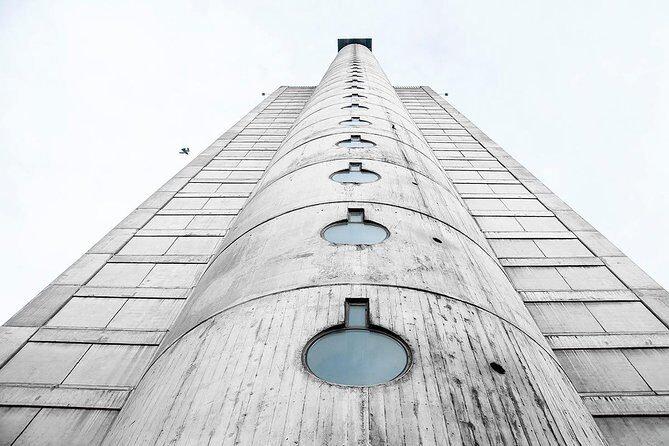
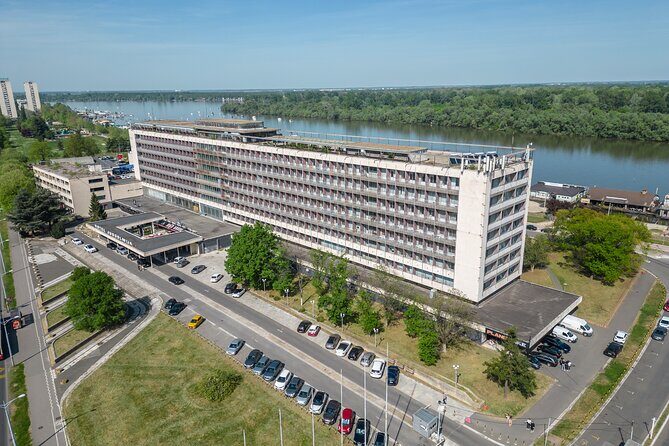
At Narodnih heroja 45, you get close to Genex Tower, also known as the Western City Gate of Belgrade. It is a 30-floor structure, and it is one of those spots New Belgrade fans love because it photographs so well.
From the tour angle, the main reason it matters is architectural reputation. Built about 40 years ago, it is described as the first smart building in the Balkans, and it also appeared in international architecture reviews as an example of brutalism. Your guide connects those labels to what you can see from the ground: the bold massing, the concrete language, and the way the tower reads as an entrance to a whole city plan.
Admission is free for this stop, and it is about 20 minutes, which feels like enough time to get your bearings and understand why people talk about it.
One practical note: because it is such a photogenic landmark, it can draw attention from passersby. If you want cleaner shots, keep your timing flexible and listen to what your guide suggests for positioning.

Sava Center: the congress machine built fast, still feeling usable
Your final major stop is Sava Center, a massive congress center built at the end of the 1970s in record times. The tour frames it as the first building of that sort in this part of Europe, and it is still in function today.
This is where I think the tour earns extra credit. Many architecture tours end with a “look at the façade” moment. Here, you also get notes about interior solutions that feel surprisingly fresh even after 40 years. That matters, because brutalism is often judged from the outside, but the real question is whether the space works for people.
You spend about 15 minutes here. Admission is free, and that makes it a good capstone: you finish with a building that is not frozen in time. It is a living piece of the city’s built experiment.
Block 23 and Primary School Laza Kostić: concrete expressionism with real routines
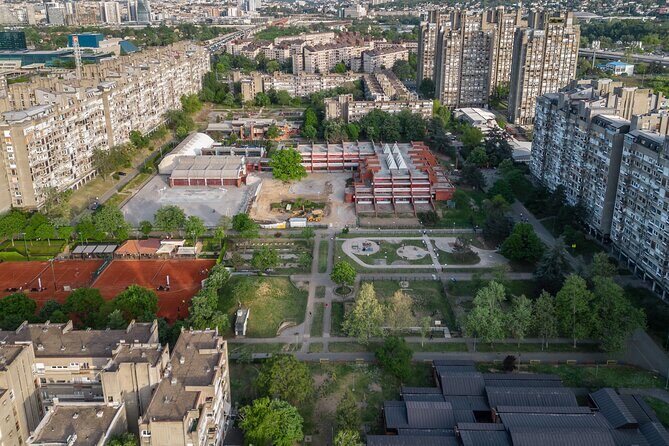
The tour closes at Primary School Laza Kostić inside Block no. 23, described as one of the most representative public housing projects in New Belgrade. Here, the architectural language is linked to concrete expressionism, and your guide focuses on the concept behind the block, not only the style.
The key idea is planning for life inside the complex. The block included apartment buildings plus a school, a kindergarten, sport courts, and even a mini shopping mall. In other words, it was designed so residents did not have to rely on distant services for daily needs.
This stop is also the emotional heart of the tour. Your guide shares personal stories of life in the blocks during the 60s, 70s, and 80s, when conditions felt like a golden era, and then what life became like during the 90s when things were not so great. You walk away thinking about brutalism as more than a visual style. It becomes a way of organizing community.
You get about 15 minutes here, and admission is free. It is short, but it is also the stop where the tour’s theme clicks hardest: form and function, plus the human cost of political and economic shifts.
Price and timing: is $86.42 per person good value?
For $86.42 per person, you are buying a guided route that covers five major New Belgrade architecture stops in about 2 hours 30 minutes, in English, in a private format where only your group joins.
The value math is helped by admissions. Park Prijateljstva, the stops tied to Genex Tower, Sava Center, and Primary School Laza Kostić are all listed as free. The Museum of Contemporary Art entry is the only one called out as not included. If you are the type who wants architecture context without hunting tickets and directions, that bundled guidance is what you are paying for.
Timing is compact but not chaotic. Each site gets a clear slot—20 minutes at the museum, 15 at the park, 20 at Genex Tower, 15 at Sava Center, and 15 at the school—with car time for the government building sightline.
The private format also matters. One theme that shows up strongly in feedback is how well the guide handles pacing and explanation. A guide who is on time and connects buildings to the daily human story is what makes this tour land.
If you want extra time at a favorite stop, you will likely need to add independent time afterward, since the tour itself is structured to finish at Sava Center.
Should you book Architecture of New Belgrade – Brutalism Decoded?
Book it if you want New Belgrade with context. This tour is best for people who like architecture, yes, but also for anyone who wants the “why” behind the concrete—politics, planning ideas, and what daily life felt like in those blocks. The route is also a great way to see major sites in one go without piecing together the city on your own.
Skip it if you hate moving quickly between viewpoints, or if you only want gentle, postcard-style sightseeing. This is not that. It is a focused brutalism decoding experience, with stops that reward attention.
If you book, I suggest going in with one question ready: What did planners think they were building for people? Then each stop—marble versus modernist expectations, peace symbolism in the park, a government-building shift during construction, Genex Tower as a city gate, and Block 23 as an entire self-contained life system—will make more sense.
FAQ
Where do I meet the guide?
You start at the Museum of Contemporary Art at Ušće, located at Ušće 10, Beograd, Serbia.
When does the tour end?
The tour ends at Sava Center, Milentija Popovića 9, Beograd 11000, Serbia.
How long is the Architecture of New Belgrade – Brutalism Decoded tour?
It runs about 2 hours 30 minutes.
Is this a private tour?
Yes. It is private, and only your group will participate.
What language is the tour offered in?
The tour is offered in English.
Do I need tickets for the stops?
Most stops are free, but the Museum of Contemporary Art ticket is not included, so you will need to cover that entry separately.
Is the tour near public transportation?
Yes, it is listed as near public transportation.
Is it suitable for most travelers?
Most travelers can participate.
Is there free cancellation?
Yes, cancellation is free. You can cancel up to 24 hours in advance for a full refund.
FAQ
What kind of ticket do I get?
You receive a mobile ticket.
Is confirmation provided after booking?
Yes, confirmation is received at the time of booking.